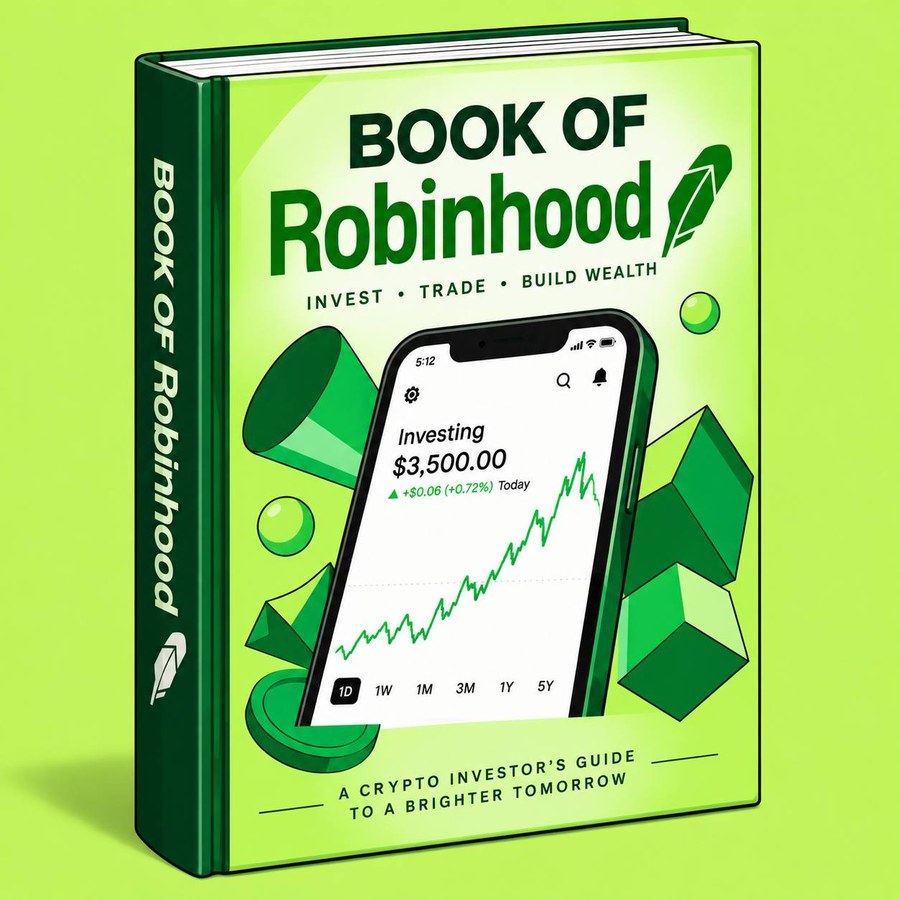
Open the book
Open the book
A field guide, of sorts
Twelve lessons the chart teaches everybody
and almost nobody writes down.
Book of Robinhood · First Edition
This is a memecoin. It has no revenue, no roadmap worth the name, and no claim on anything. What it has is a book, a chart, and a group of people who decided the joke was worth paying attention to.
Everything printed inside is written to be true and funny in that order. None of it is financial advice, and any of it will cost you money if you treat it as a guarantee. Assume you can lose the whole position, because you can.
Verify the contract address on the final page against the official account before you touch anything. Anything else claiming to be this is not.
— the desk
The top is not a price. It is a feeling of certainty.
You will recognise the top by how obvious everything has become. The chart is green in every timeframe. The group chat has stopped arguing. Someone you have never seen post before is posting. At that moment the trade has finished being an idea and started being a consensus, and consensus is the last thing that gets priced in. The market does not ring a bell at the top because the bell is you, telling your friends.
The lessonIf it feels safe, you are late.
Every dip has a basement, and every basement has a trapdoor.
A dip is a discount that has not finished happening yet. You will hear that it is a gift, and sometimes it is, but a gift and a warning arrive in the same envelope and the envelope is unmarked. The honest version is that you cannot tell which one you are holding until later. So buy the dip in a size that survives being wrong about it, and stop calling the second one an opportunity when it is really just the first one continuing.
The lessonThe dip is only a dip in hindsight.
Conviction is a thesis you can say out loud. Everything else is a hostage situation.
Diamond hands are praised because holding is hard, but holding is only a virtue when there is a reason underneath it. Write your reason down before you enter. If you cannot state it in one sentence without mentioning the price you paid, you do not have conviction. You have an anchor. The market is indifferent to your entry, and the sooner you become indifferent to it too, the sooner you can make a decision instead of a defence.
The lessonWrite the thesis first. Read it when it hurts.
Reading the ticker twice is not research.
Real research is boring. Who deployed it. Who holds it. What happens to the liquidity. Whether the people involved have ever finished anything. None of that is fun, which is precisely why almost nobody does it, and why the small amount you do puts you ahead of most of the people typing confidently around you. You do not need an edge over the market. You need an edge over the version of yourself that was about to click buy.
The lessonTen minutes of reading beats ten opinions.
Somebody in the room is the exit. The room will not tell you who.
There is always a chat you are not in, and believing otherwise is the most expensive assumption in this business. Information moves in rings, and by the time it reaches an open channel it has already been priced by three closed ones. This is not a conspiracy; it is just how attention travels. Treat every call you receive for free as a call somebody else received earlier, and size accordingly.
The lessonIf you cannot identify the exit liquidity, you are it.
The correct size is the one that lets you think clearly.
Every rule about risk is really a rule about sleep. A position that wakes you at four in the morning has already cost you more than it can pay, because you will manage it badly and you will manage everything next to it badly too. There is no formula here that beats the simple test: could this go to zero without changing your life. If the answer is no, the position is too big, regardless of how good it is.
The lessonSize it so you can sleep. Then halve it.
Long term is a phrase we discover shortly after the entry goes wrong.
Time horizons should be chosen before the trade, not assigned to it afterwards as a consolation. A swing does not become an investment because it is down, and a bag does not become a portfolio because you have held it through two seasons. Decide what you are doing and for how long, then let the outcome be the outcome. Renaming a loss is not a strategy; it is a way of never having to take one.
The lessonChoose the horizon before the entry, not after.
This chapter is short because nobody has ever written it well.
The lessonSell something. Anything. Start there.
The chart records the past perfectly and predicts nothing.
Patterns are real in the sense that other people are looking at them, which makes them briefly self-fulfilling and permanently unreliable. Use levels as places to make decisions, not as prophecy. The most useful thing a chart tells you is where you would be wrong, and the discipline is to write that number down before you are emotionally involved with it. Everything past that is decoration.
The lessonMark where you are wrong. Then trade.
The ticker is the tribe.
Value in this corner of the market is not produced by a product; it is produced by a group of people agreeing to keep paying attention to the same joke. That is a fragile thing and an honest one, provided nobody pretends otherwise. Judge a community by what it does on a red day. If it goes quiet, it was never a community. It was a crowd standing near a number.
The lessonWatch how they behave on the red day.
Grief is about five candles long.
It happens. Sometimes to good people and often to careful ones. Do not spend a month litigating it in your own head; the market has already moved on and it will not be issuing an apology. Take the lesson, which is almost always about size or about trust, write it in one line, and close the tab. The worst outcome is not the loss. It is the revenge trade you make trying to erase it.
The lessonTake the lesson. Skip the revenge trade.
The book has no last page.
Every cycle produces a new set of people who are certain they are early and an older set who are certain it is over, and both are describing the same chart. You will be in both groups eventually. The only durable edge is the willingness to keep showing up with a smaller ego and a written plan. Close the book, open the chart, size it properly, and start again.
The lessonSmaller ego. Written plan. Begin.
One contract address. Check it here, or on the official account. Nowhere else.
0xAB749DC7abEAB101B938C7b201E03DC64D038aeb
Launching through Pons. Chart goes live on DEX Screener the moment the pool opens.
“Smaller ego.
Written plan.
Begin.”
Twelve chapters on the only market that reads back. Not advice. Not a promise. A book, a chart, and a room full of people who showed up.

Book of Robinhood · $BORH